Breaking Down What Is Digital Transformation
Digital transformation is the process of using digital technology to fundamentally change how a business operates and delivers value to its customers. It’s not simply about buying new software or moving files to the cloud. It’s about rethinking the way work actually gets done, using technology as the enabler rather than treating it as the end goal.
The phrase gets thrown around a lot, often attached to anything involving a computer, which has made it feel vaguer than it needs to be. Stripped back to basics, digital transformation covers three connected things: the technology itself, the processes that technology supports, and the people who have to actually use it day to day. Miss any one of those three and the “transformation” part tends to stall, even if the technology works perfectly well on its own.
It helps to separate digital transformation from two things it often gets confused with. Digitisation is converting something analogue into a digital format, scanning a paper form into a PDF, for example. Digitisation is a small, mechanical step. Digital transformation is what happens when that shift changes the process around it too, so the form isn’t just digital, it’s automatically routed, tracked, and actioned without anyone needing to chase it manually. The second point of confusion is IT support itself. Keeping systems running, patched, and secure is essential groundwork, but it’s not transformation on its own. Transformation is what a business chooses to build on top of that stable foundation.
For most small and medium-sized businesses, digital transformation isn’t one big dramatic overhaul. It’s usually a series of deliberate changes: replacing a manual spreadsheet process with proper business software, moving customer data out of scattered inboxes and into a shared system, or giving staff the tools to work securely from anywhere rather than being tied to one office. Individually, none of these feel revolutionary. Together, they change how a business actually functions.
Digital Transformation in Business
Once you strip away the buzzword, digital transformation in business tends to show up in a handful of recognisable ways. It’s rarely one single project with a start and end date. It’s closer to an ongoing shift in how a company gets work done, layered on gradually as old processes stop being good enough.
The most visible starting point is usually communication and collaboration. Businesses that once relied on email chains, physical meetings, and paper sign-off sheets move to shared platforms where documents, conversations, and approvals live in one place, accessible whether someone is in the office, at a client site, or working from home. This alone changes how quickly decisions get made, simply because information stops getting stuck in one person’s inbox.
The next layer is usually data. Many businesses generate far more information than they actually use, sales figures, customer interactions, stock levels, all sitting in separate systems that don’t talk to each other. Digital transformation in business often means connecting those systems so decisions can be based on what’s actually happening right now, rather than a manager’s best guess or last month’s spreadsheet.
Customer-facing change tends to follow. A business that once took orders over the phone might introduce online booking, self-service account portals, or automated updates that keep customers informed without anyone needing to make a call. None of this replaces the relationship a business has with its customers, but it removes the friction that used to sit around it.
Underneath all of this sits infrastructure, the part that rarely gets noticed when it works and causes serious problems when it doesn’t. Moving core systems to the cloud, securing endpoints properly, and building in redundancy so a single failure doesn’t halt the whole business are less glamorous than customer-facing change, but they’re what makes the rest of it sustainable rather than fragile.
What ties all of these together is that digital transformation in business isn’t a department’s job or a one-off IT project. It touches sales, operations, customer service, and leadership at the same time, which is exactly why it tends to succeed or fail based on how well those parts work together rather than on the technology alone.3

Why Digital Transformation Matters
The honest answer to “why does this matter” is competitive pressure. Businesses that have modernised how they operate are simply faster, more resilient, and more able to respond to change than those still running on manual processes and disconnected systems. That gap tends to widen over time rather than staying fixed, which is why so many businesses that delay digital transformation eventually find themselves catching up rather than keeping pace.
The most immediate benefit is efficiency. Automating repetitive tasks, invoice processing, appointment scheduling, data entry, frees up staff time for work that actually needs a person’s judgement. It also removes a surprising amount of quiet, everyday friction: the chasing, the re-entering of the same data into three different systems, the waiting for someone to be back at their desk to approve something. None of that shows up as a dramatic headline, but it adds up to real hours saved every week.
Better decision-making follows closely behind. When data lives in one connected system rather than scattered across spreadsheets and inboxes, leaders can see what’s actually happening in the business in something close to real time, rather than working from a report that was accurate a month ago. That matters most when something goes wrong and speed of response is what limits the damage.
Resilience is another benefit that’s easy to underrate until it’s tested. Businesses with modern, cloud-based systems and proper backup and continuity planning can keep operating through disruptions, a hardware failure, a site becoming unavailable, a member of staff being off sick unexpectedly, that would stop a business running on ageing, single-point-of-failure infrastructure. This is where digital transformation and cyber security overlap most directly, since resilience depends on systems being both connected and properly protected.
There’s also a genuine people benefit that gets overlooked. Staff who are given decent tools tend to be more productive and less frustrated day to day. Recruitment and retention are affected by this too; it’s increasingly rare for people, particularly younger staff, to accept working with outdated systems when they know better tools exist.
Finally, digital transformation tends to improve the customer experience almost as a side effect of everything above. Faster response times, more accurate information, and fewer errors caused by manual processes all filter through to how a business is experienced from the outside, even when the changes themselves happened entirely behind the scenes.
Taken together, these benefits explain why digital transformation isn’t really optional in the way it might have felt a decade ago. It’s become the baseline businesses are compared against, whether they’ve consciously chosen to compete on it or not.
Benefits of Digital Transformation
- Greater efficiency and less manual work
- Faster, better-informed decision-making
- Stronger business resilience
- Improved cyber security
- Higher staff productivity and retention
- Better customer experience
- Lower long-term operating costs
- Easier scaling as the business grows
- Fewer errors from manual processes
- Better visibility across the whole business

A Simple Digital Transformation Framework
Digital transformation goes wrong most often when it starts with technology rather than a plan. A business buys new software because a competitor has it, or because a salesperson made a convincing pitch, and only afterwards works out how it should actually change the way people work. A simple framework avoids that by keeping the order deliberate: people, process, then technology.
1. People first
Start with who’s affected and what they actually need. This means talking to the staff who’ll use the new systems day to day, not just the leadership team signing off the budget. Their buy-in decides whether the change sticks, and their frustrations with the current way of working are usually the best guide to what needs to change first.
2. Then process
Once you understand the people side, look at how work currently flows: where the delays are, where information gets duplicated, where something depends entirely on one person being available. Map the process as it actually happens, not as it’s supposed to happen on paper. This step often reveals that the real problem isn’t a lack of technology at all, it’s a process that’s never been questioned.
3. Technology last
Only once the process is clear does it make sense to choose the technology that supports it. This is the reverse of how many transformation projects start, and it’s why this order matters: technology chosen to fix a genuine, understood problem gets used properly, while technology bought first and fitted around afterwards tends to get abandoned within a year.
4. Review and adjust
Digital transformation isn’t a single rollout with a finish line. Once new tools and processes are in place, the businesses that get the most value keep checking whether they’re actually working, gathering feedback from staff, tracking whether the original problem has genuinely improved, and adjusting rather than assuming the first version was right.
Keeping the framework this simple matters more than it sounds. Digital transformation strategy documents can run to dozens of pages, but most small and medium-sized businesses get further with a plan they can actually hold in their head and revisit, than with a framework so detailed it never survives contact with the working week.
Why Digital Transformation Projects Fail (and How to Avoid It)?
Digital transformation projects fail more often than most businesses expect, and it’s rarely down to the technology itself. Software these days is generally reliable. What derails projects is almost always something more human: unclear goals, poor planning, or people who were never properly brought along with the change.
The most common cause is starting without a clear problem to solve. A business decides it needs to “do digital transformation” because it feels like the right thing to do, without first agreeing what specifically should improve. Without that target, it becomes almost impossible to tell whether the project has actually worked, and easy for it to drift, lose budget, or quietly stall.
Poor staff engagement is close behind. A new system rolled out without proper explanation, training, or time to adjust tends to get resisted, worked around, or ignored in favour of the old way of doing things. Staff who feel a change was done to them, rather than with them, have little reason to make it succeed.
Trying to do too much at once is another common trap. Businesses that attempt to overhaul several systems and processes simultaneously often end up overwhelming both the team delivering the change and the staff expected to adopt it. Smaller, sequenced changes tend to succeed more reliably than one sprawling project with too many moving parts.
Underestimating the process side matters too. It’s tempting to treat new technology as the whole solution, but technology layered on top of a broken or outdated process usually just makes the existing problem faster, not better. This is why the people-process-technology order from the framework above matters in practice, not just on paper.
Finally, a lack of ongoing ownership causes projects that started well to fade. Once the initial rollout is done, if no one is responsible for checking adoption, gathering feedback, and making adjustments, usage quietly drops and the business drifts back towards its old habits.
None of these causes are really about technology failing. They’re about a project being under-planned, under-communicated, or left without anyone genuinely responsible for making it work.

Digital Transformation for SMEs
Most of the language around digital transformation is written with large enterprises in mind, multi-year programmes, dedicated transformation teams, seven-figure budgets. For a small or medium-sized business, that framing can make the whole idea feel out of reach, which is a shame, because SMEs are often better placed to benefit from digital transformation than larger organisations are.
The main advantage SMEs have is speed. A smaller business doesn’t need months of internal sign-off across multiple departments to change how something works. A decision made by an owner or small leadership team can be implemented within weeks, tested properly, and adjusted if it isn’t working, something a large enterprise structurally can’t do as easily.
The starting point also looks different. SMEs rarely need a sweeping, multi-system overhaul. More often, digital transformation for an SME means fixing the specific bottleneck that’s actually holding the business back: a booking process that still runs through phone calls and a paper diary, financial reporting that depends on one person’s personal spreadsheet, or customer records spread across email, memory, and sticky notes. Solving one genuine problem well tends to do more for an SME than attempting to modernise everything at once.
Budget is understandably the biggest concern for most SMEs considering this kind of change, and it’s a fair one. The reassuring part is that digital transformation doesn’t require enterprise-level spending to deliver real value. Cloud-based tools, in particular, have made capable systems accessible at a monthly cost that scales with the size of the business, rather than demanding a large upfront investment in hardware and licensing.
The other advantage SMEs have is culture. In a smaller team, it’s genuinely possible for every member of staff to understand why a change is happening and to be part of shaping how it works, rather than change being announced from a head office several layers removed from the people actually affected. That closeness is often what makes the “people first” part of the framework above easier to get right in an SME than in a larger business.
None of this means digital transformation is simple for smaller businesses, only that it’s more achievable than the enterprise-focused language usually suggests. The right partner, one who understands SME budgets and SME timescales rather than applying an enterprise playbook regardless of size, tends to matter more here than the scale of the technology itself.
Digital transformation looks different depending on the industry, shaped by what each sector actually needs to solve. A few examples show how the same underlying principles play out in practice.

Healthcare
Digital transformation in healthcare tends to centre on patient data and access. For decades, patient information lived in paper files that could only exist in one place at a time, which meant a specialist, a GP, and a hospital treating the same patient were often working from entirely separate records. Moving that data into shared electronic systems means the full picture travels with the patient rather than being rebuilt from scratch at every appointment. Remote consultations have removed a similar barrier, letting patients access care without a physical visit being the only option, which matters most for those who struggle to travel or live in rural areas. Throughout all of this, security and compliance sit above everything else, given how sensitive the data involved is and how tightly regulated its handling needs to be.
- Electronic patient records replacing paper-based systems
- Secure remote consultations and video appointments
- Shared systems across different parts of a care pathway
- Wearable and remote monitoring devices feeding data back to clinicians
- Strict compliance and data protection requirements throughout
Finance
In financial services, digital transformation is largely about speed and trust, two things that used to sit in tension with each other but increasingly don’t have to. Automated fraud detection systems can now flag suspicious activity in real time rather than after the damage is done, which has become essential as the volume and sophistication of financial fraud has grown. Self-service tools have shifted expectations too; a customer managing their own account, moving money, or checking a transaction without visiting a branch or waiting on hold has become the baseline expectation rather than a convenience. Faster transaction processing sits underneath most of this, since much of finance is ultimately a speed game, whoever can process, verify and settle fastest tends to win the customer’s trust. Regulatory compliance shapes almost every decision made in this sector, often more than the technology itself does.
- Automated, real-time fraud detection
- Self-service account management and transactions
- Faster transaction processing and settlement
- Open banking and system interoperability
- Compliance and regulatory reporting built into every system

Manufacturing
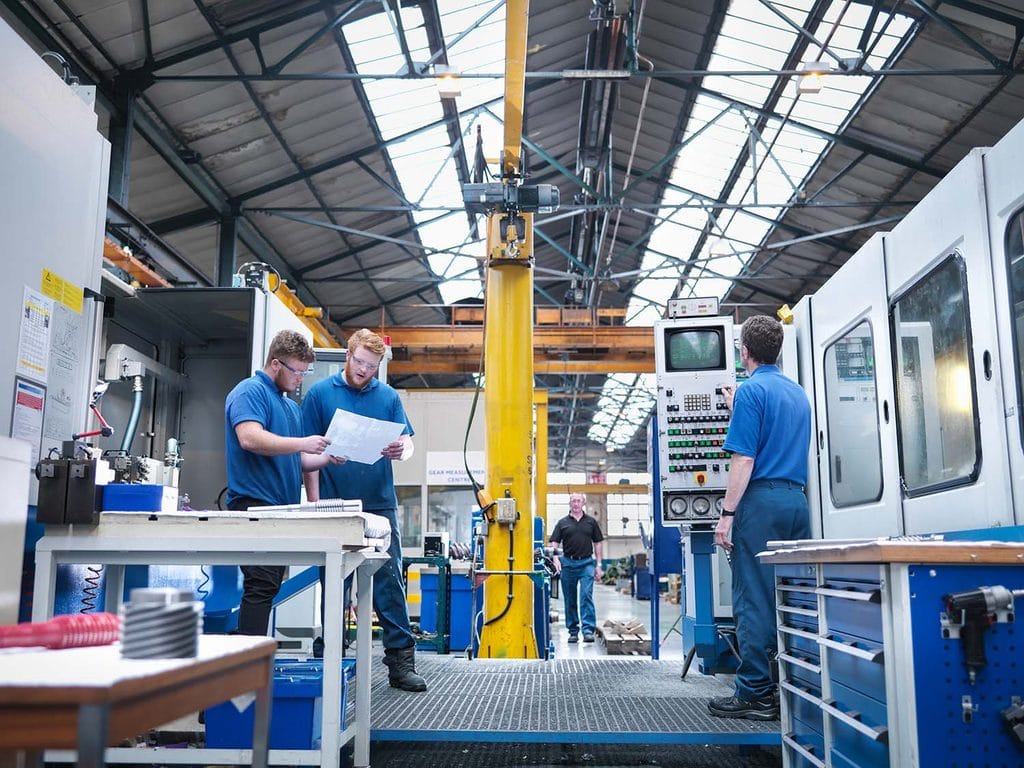
Manufacturing has leaned heavily into connected equipment, using sensors fitted to machinery to monitor performance and flag maintenance needs before a breakdown happens, rather than after. This shift from reactive to predictive maintenance is one of the clearest examples of digital transformation changing not just how a process runs, but what a business can offer as a result. A manufacturer that once simply sold equipment can now sell ongoing monitoring and maintenance as a service, built entirely on the data that connected equipment generates. Beyond maintenance, connected systems on the factory floor allow production data to be tracked in real time, making it far easier to spot bottlenecks, quality issues, or inefficiencies while they’re still small rather than discovering them at the end of a production run.
- Sensor-based predictive maintenance
- Real-time production monitoring and reporting
- Automated quality control checks
- Connected supply chain and inventory tracking
- New service-based revenue built on equipment data
Education
In education, digital transformation has meant moving learning materials, assessment, and communication into digital systems that staff, students and parents can all access from wherever they are. This shift accelerated sharply in recent years and has largely stayed in place, since both staff and students discovered genuine benefits in tools that once felt like a temporary fix. Tracking student progress in real time, rather than waiting for end-of-term results, has changed how early intervention works; a struggling student can now be identified and supported weeks earlier than a termly report card would have allowed. Administrative systems have modernised alongside teaching itself, reducing the time staff spend on manual record-keeping so more of it can go towards actual teaching.
- Online learning materials and virtual classrooms
- Real-time student progress tracking
- Digital assessment and automated marking tools
- Streamlined communication between staff, students and parents
- Reduced administrative burden through connected systems


Public sector
Public sector organisations tend to focus digital transformation on making services more accessible, moving forms, applications and requests that once required a physical visit or a posted letter into online systems that can be completed at any time. This matters particularly for residents who find traditional office hours difficult to work around. Behind the scenes, a significant part of public sector transformation is less visible but just as important: connecting systems that were built separately over many years, often by different departments using different suppliers, and were never designed to talk to each other. Bringing that data together properly tends to reduce duplication, cut waiting times, and make it easier to spot where services are falling short.
- Online forms and digital service applications
- Integration of previously siloed legacy systems
- Reduced reliance on paper-based processes
- Improved data sharing between departments
- Better visibility into where services need improvement
Getting Started with Digital Transformation
None of this needs to start with a large project plan or a significant budget commitment. The businesses that get the most out of digital transformation usually begin by identifying one genuine bottleneck, the process that everyone quietly complains about but nobody has fixed, and solving that properly before moving on to the next.
A useful starting question is simple: what’s the task that takes longer than it should, or the information that’s harder to find than it needs to be? That single answer usually points towards the first sensible step, whether that’s automating a manual process, connecting two systems that currently don’t talk to each other, or giving staff secure access to the tools they need from wherever they’re working.
From there, the people-process-technology framework covered earlier gives a practical way to keep the project grounded: understand who’s affected, fix the process itself, then choose technology that genuinely supports it rather than technology chosen first and worked around afterwards.
Sentinel works with businesses across Hampshire, Dorset, Wiltshire, Surrey and Berkshire on exactly this kind of change, from fixing a single process that’s holding a team back to planning a wider shift in how a business operates. As a Cyber Essentials Plus-certified provider, every recommendation is made with security built in from the start, not added as an afterthought once something’s already in place.
If you’re not sure where your own digital transformation should begin, that’s a reasonable place to start the conversation. Get in touch with Sentinel to talk through what’s actually slowing your business down, and what could realistically change first.